
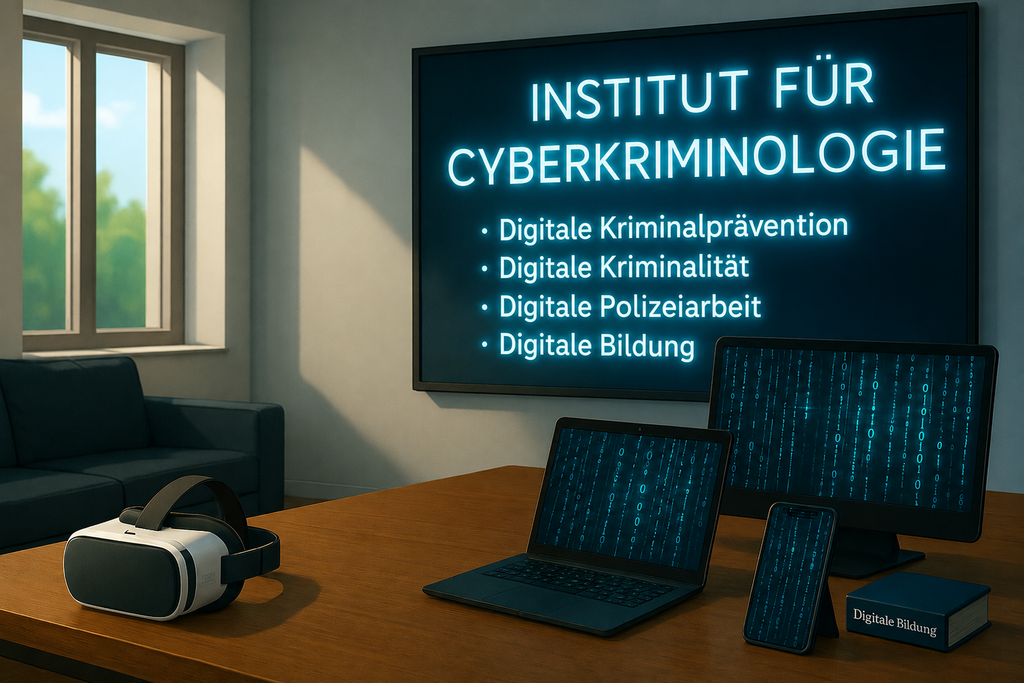
Cyberkriminologie
About the Institute
Founded in 2022, the Institute for Cybercriminology at the Police University of the State of Brandenburg is the first of its kind in the German-speaking world.
It addresses the criminal policy and societal challenges, as well as the specific characteristics of crime commission, crime prevention, and law enforcement in the digital age.
The Institute sees itself as a platform for scientific exchange and offers a first opportunity for networking and dialogue in the still emerging research field of cybercriminology. This includes the promotion of interdisciplinary collaboration—both nationally and internationally.
Leader
The Institute is headed by Professor Dr. Thomas-Gabriel Rüdiger.
His research focuses on digital crime, interaction risks in social media, digital policing, crime prevention, and the emergence and control of norm violations in the digital space.
Contact:
Prof. Dr. Thomas-Gabriel Rüdiger
Institute for Cybercriminology
Police University of the State of Brandenburg
Bernauer Straße 146, 16515 Oranienburg
Email:
Further information: Prof.Dr. Thomas-Gabriel Rüdiger
Research Topics
The Institute functions as an interdisciplinary interface, primarily connecting criminology with social sciences, legal studies, education, media, and police sciences. Its research includes:
• Forms and manifestations of digital crime, such as:
o Digital sexual offenses (e.g., cybergrooming, sextortion, abuse imagery [CSAM])
o Digital hate crimes,
o The use of artificial intelligence to commit crimes
• Causes and dynamics of norm violations on the internet
• Possibilities for digital crime prevention
• The relevance of digital education
• The impact of child and youth media protection on digital crime
• The role of media literacy in preventing digital offenses
Public Engagement and Networking
A key objective of the Institute is to raise public awareness about digital crime and its societal, particularly social and criminopolitical, implications.
To this end, the Institute regularly hosts conferences and informational events, publishes materials for professionals and interested individuals, and is available for media inquiries.
It is especially committed to digital crime prevention for all age groups.
Internships
In exceptional and well-justified cases, the Institute offers the opportunity to complete an internship.
Such an internship requires enrollment in a Master’s program and proven knowledge in the field of cybercriminology, which may be demonstrated through relevant academic theses, for example.
Supervision of External Master's Theses
Supervision of external, subject-specific Master’s theses by the Institute's director is possible.
Applications must include a scientific exposé.
Initial supervision of doctoral theses is not possible at the Police University of Brandenburg, but secondary supervision may be considered.
Leitung
Geleitet wird das Institut von Prof. Dr. Thomas-Gabriel Rüdiger. Seine Forschungsschwerpunkte umfassen digitale Kriminalität, Interaktionsrisiken sozialer Medien, digitale Polizeiarbeit, Kriminalprävention sowie die Entstehung und Kontrolle von Normbrüchen im digitalen Raum.
Prof. Dr. Thomas-Gabriel Rüdiger
E-Mail: thomas.ruediger(at)hpolbb.de
Weiterführende Informationen: Prof.Dr. Thomas-Gabriel Rüdiger
Soziale Medien: Instagram, Linkedin
Assoziierte Wissenschaftler : Cindy Ehlert, M.A.und Prof. Dr. phil. Dipl.-Psych. Jürgen Biedermann

Öffentlichkeitsarbeit und Vernetzung
Ein zentrales Anliegen des Instituts ist es, das Thema „digitale Kriminalität” und dessen gesellschaftliche, vor allem auch sozialen und kriminalpolitischen Auswirkungen, sichtbarer zu machen und in die Öffentlichkeit zu tragen. Zu diesem Zweck richtet das Institut regelmäßig Tagungen und Informationsveranstaltungen aus, veröffentlicht Publikationen für Fachleute und Interessierte und steht für Medienanfragen zur Verfügung. Dabei fühlt sich das Institut in einem besonderen Maße der digitalen Kriminalprävention für alle Altersstufen verpflichtet.
Praktikum
Das Institut bietet in begründeten Ausnahmefällen die Möglichkeit, ein Praktikum zu absolvieren. Grundlage für ein solches Praktikum ist ein laufender Masterstudiengang sowie nachgewiesene Kenntnisse im Bereich der Cyberkriminologie, die beispielsweise durch passende Abschlussarbeiten nachgewiesen werden können.
Betreuung von externen Masterarbeiten
Eine Betreuung von externen, fachspezifischen Masterarbeiten durch die Institutsleitung ist denkbar. Die Bewerbung muss ein wissenschaftliches Exposé umfassen.
Eine Erstbetreuung von Promotionen ist an der HpolBB nicht möglich, eine Zweitbetreuung ist jedoch denkbar.
Aktuelle Meldungen

Institut für Cyberkriminologie wirkt im Ethikbeirat des EU-Projekts OSPREY mit
Das EU-Projekt OSPREY erforscht den Schutz von Polizei und Politik vor digitalen Bedrohungen.
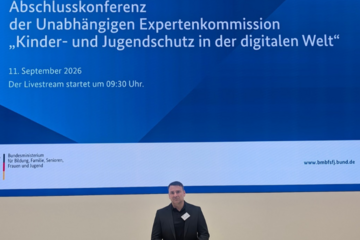
Abschlusskonferenz der Expertenkommission zum Kinder- und Jugendschutz in der digitalen Welt
Nach knapp einem Jahr hat die unabhängige Expertenkommission „Kinder- und Jugendschutz in der digitalen Welt“ ihre Arbeit mit 56 Handlungsempfehlungen…

Kriminologische Einordnung von Cybermobbing für Klicksafe-Schulstunde durch Institut für Cyberkriminologie
Prof. Dr. Thomas-Gabriel Rüdiger ordnete Cybermobbing für die klicksafe-Schulstunde aus kriminologischer Perspektive ein.

Institut für Cyberkriminologie auf der Gamescom 2026
Auf Einladung der Gamesbranche diskutierten Innenminister Dr. Jan Redmann, Staatssekretär Dr. Jörg Treffke und Prof. Dr. Thomas-Gabriel Rüdiger über…

Berufung von Prof. Dr. Rüdiger in den Expertenbeirat von CytZuReDen
Der Leiter des Instituts für Cyberkriminologie Prof. Dr. Thomas-Gabriel Rüdiger wurde in Anwesenheit der Vizepräsidentin der HPol Prof. Dr. Imme…